

20 years ago (or so) a candle sparked into life and it feels like it's never burned out. It was a community candle, a discovery that lit a fire in me and has kept me going ever since.
I still feel like I can't put why I feel so strongly about community into words. Maybe that's why, almost 800 posts into Rosieland, I keep writing. Writing helps me process my thoughts.
I've wondered whether perhaps I'm just a bit cuckoo thinking that building a different kind of business, with community thinking, a community-led one is daft thinking. And then I remind myself, I'm already doing it. 🫠
Along the way I've had crises'. Questioning myself. My ability. Whether what I do matters. How people say they want community, but in reality everything and anything they do actually leads to the opposite.
And then getting handed an AuDHD (Autism + ADHD) diagnosis (3 years ago) made me wonder what makes me equipped to build community, with so many "social communication deficiencies" surely that not only alienates me from the world that we exist within, but in theory it puts me at a disadvantage as I simply cannot exist with in the "neurotypical" world.
How can I build community when the world around me is disabling? It feels like it shouldn't be possible and that I'm in the wrong career. If I could describe myself growing up until diagnosis, it would look like this.
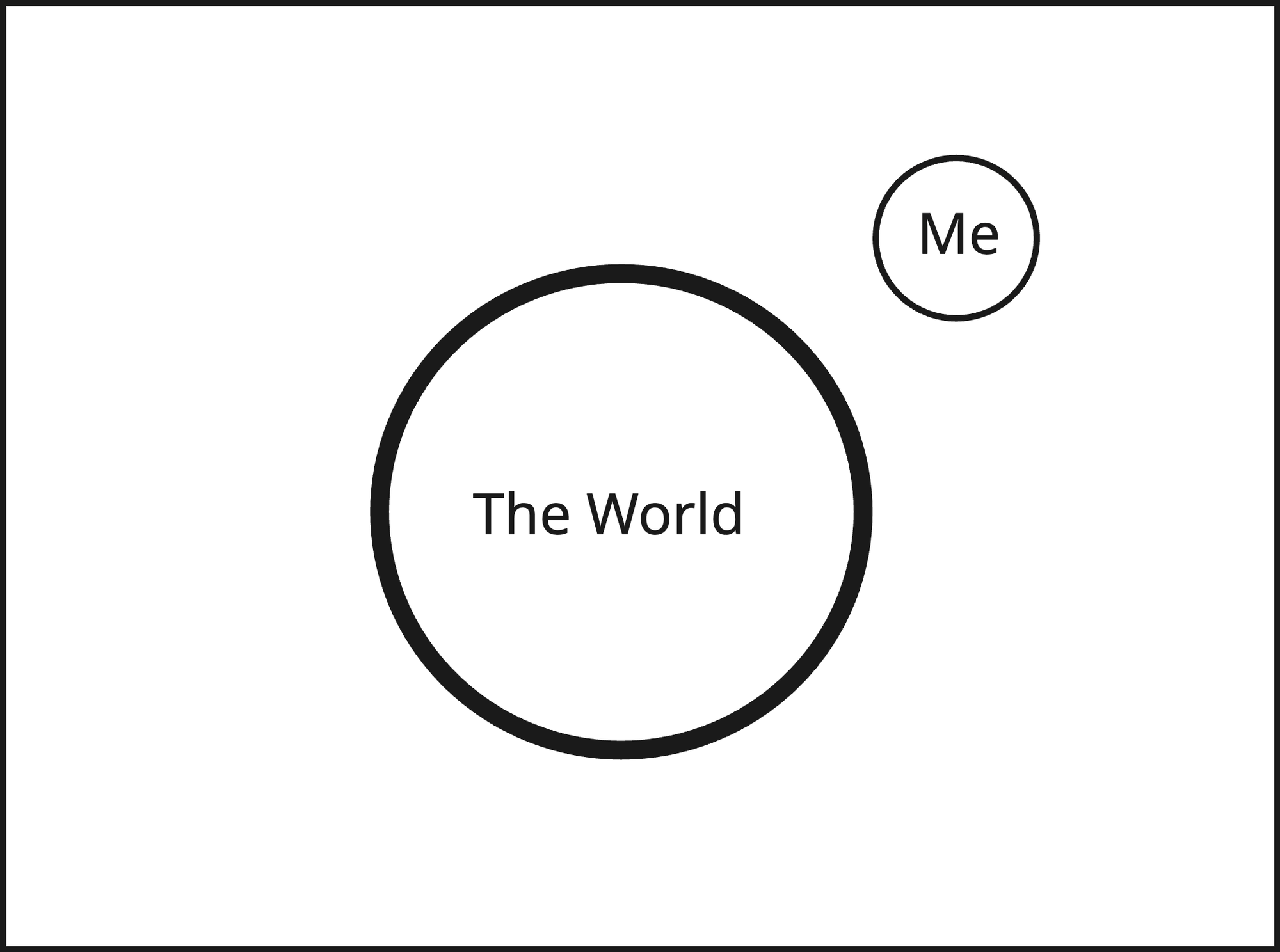
In some sense this is a representation of not belonging, which can happen to anyone. However, the reality is that for the neurodivergent, it's 100x harder to find a path into the world. We are excluded, usually unintentionally, but it's still exclusion.
This image is me partly in my own world, in my head, which autism is well known for being described as. I mean, even the name Rosieland came before my diagnosis, but it's funny that I used to say that I just wanted to express what was in my head, Rosieland is an expression and creation of the world that exists in my head. (I hope you like it!)
The image is also an expression of being excluded from the world. So many aspects of the world is disabling for people like me. It explains why I reject things in life, like normal jobs, school and superficial socialising. My diagnosis explains it and it starts to make sense, as much as it hurts, it's also a relief.
We can also look at the image of 'the world' that is impenetrable by myself. I just couldn't find a way in. Which leads to not belonging, or being othered. But that is simply a symptom of lack of understanding, from myself as much as the rest of the world.
As I picked myself up, learned more about neurodiversity, learned to make sense of myself. Along the way I realised there are many practical ways to exist and adapt the world for neurodivergents that neurotypicals love too.
Much of this goes back to the idea of accessibility, if you design something for the disabled, it actually makes it better for everyone. We all have the potential of being disabled at any point in our lives, sometimes temporarily, sometimes forever, so we may as well design for it.
Yet, when it comes to community, few people actually talk about this. We talk about conversations, value, ROI, metrics and the need to engage. We may talk about accessibility from a tech perspective, but it rarely goes past that.
From a neurodivergence perspective, there is very little understanding. We don't have to design separate spaces, we need to design inclusively with neurodiversity in mind and along the way, the experiences will become better.
This is from my own personal limitation: I simply can't do group conversations, and mostly I've stopped trying.
So put me in that situation and I crumble. You won't see me struggle, but I will be. What you see is me simply not participating, you might simply label me as an introvert. Often I will quietly disappear. The reason for this is slower audio processing and needing time to think and respond, which by the time I do, I can't find a way in.
There are simple solutions around this. It doesn't mean no group conversations, it means accommodations and providing the equivalent alternative experience.
For example, put me in a 1:1 conversation and I can talk all day. I've personally doubled down on this and it's been transformative, not to mention the insights of 1:1 conversations is 100x .
The simple act of practicing turn taking is also so helpful to tackle the overwhelm of group conversations.
Group conversations are such a big part of modern life, socially, personally and in work life. When you can understand that some people struggle with them, then you can see how it so easy for them to not to thrive.
Lots of neurodivergent people dislike eye contact and and also like to keep their hands busy.
At our conference this year, we hosted a craft table and it went down a storm, for everyone, not just the neurodivergents. People were having so much fun, laughing, making bracelets, colouring mugs, and stamping notebooks.
It was the most amazing thing to witness and it was inspired by my own neurodivergence. Have a peek at what it actually looked like.
Community is not magical
We talk about how community is so magical. So impossible. So unique. So beautiful and out of reach, that there must be some unique recipe.
When we talk about community being magical, it starts to feel unattainable. That you must have special skills to make it happen. That it requires expensive expertise. That everyday people or actions make no impact.
But I'd argue it is not special or magical. Infact, it's the opposite.
Community is boring. It's doing the hard work. It's looking out for one another. It's lifting people up, when you are also down. It's about doing the invisible work. It's about good communication in a million different ways. It's about learning about neurodiversity, accessibility, disability and human nature. It's about taking action even when you think can't.
Community is caring. Which itself is draining and requires one to be proactive. The simple act of showing care often causes social media clips to go viral. It's great to see, but these are behaviours we should see every day.
Community is doing the right thing when no one else is watching. It's standing up against bad behaviour. Or standing up for your beliefs. It means turning down opportunities, or money because it doesn't align.
Community means seeing the world and changing with it. It means being creative and striving for better than what we had. It means understanding our roots, yet building for a different and better future.
Community requires creativity. Which, creativity itself, is a form of problem solving. We have to continuously find ways to solve our problems and do something meaningful.
Community is world building. We strive for and build an example of a better world, brick by brick, we show what is possible. But along the way, there are misunderstandings, failures, people throw their unhelpful opinions, we get shouted at, and barriers placed. But within this is hopefully positive progress. People are people, sometimes for the better, sometimes not. When we can see we are working towards a better world, it helps us keep going.
TLDR; Community is not magical, community arises when we are aligned to do the work with care.
Community as Minimum Viable World Building
When I think about building community, I like to think bigger. We are building a world. Not the whole world. A world, that is meaningful to us. And one that others might aspire to for themselves.
The more I build the MoTaverse, the more I see how others may want to replicate some of the things we are building.
In that sense, our communities are models, Minimum Viable Worlds that we hope that will exist, in some kind of form, across other parts of our lives or the world. It doesn't mean that the communities we build will dominate the world, it's more that others can see and relate to what we have built and will implement ideas into their own community system.
Through the communities we build people can see that there are different or better ways to exist that they are welcome to replicate for themselves.
Like, as I was writing about this, I was thinking of Brené Brown's work, which I love. Like how she talks about the opposite of belonging is fitting in. I love, love, love it. Of course, it makes sense, we shouldn't feel like we have to change to fit in, if we have to do that, then perhaps we don't belong.
Neurodivergent people even have a term for this, it's called "masking". Where we suppress who we feel we really are. Where our behaviours are not accepted by society. Suppressing "stimming" is the most common and visible example used when trying to explain this, but honestly, we are shamed in a million different ways. The consequences of this are often devastating. It leads many things, like burnout, anxiety, mental health issues, and suicide.
No one should have to mask. Behaving a certain way to fit in is a form of masking.
Yet, there is little actual practical advice on how to help and accommodate people to fit in. Our community practices don't change to help people fit in. This is a problem and also an exciting opportunity to improve the communities we create. As community people we need to do the work to help people feel like they belong. We can do better, when we start to understand humans and the system better. We can help people see they belong, by building it into our worlds. We don't have it figured out yet.
If we take the group conversations example, people can really start to feel they belong when they have the opportunity to have 1:1 conversations. This can lead to belonging, but it needs to be designed into the community. The community culture does the work of helping people belong. They can feel like they don't fit in, but then one simple conversation can flip the story and maybe help them discover if they do.
Sometimes we feel that we don't fit in simply because we don't know enough, because we haven't spent the time, or had the time to explore.
I've observed this so many times, that many people haven't felt like they belonged at Ministry of Testing until they started showing up in person. Many had bad or unaspiring experiences of previous events elsewhere and assumed ours would be the same. They had to put a bit of work to open their minds and see that things can be different.
Partly I use this as motivation for trying to figure out ways to help people realise that they do fit in earlier. This year we invested in a photographer to capture our conference in a more visual way, we hope that could potentially help people see that we are different and that they are welcome. Other times, I wonder, that maybe the challenge of communicating all the things is simply part of the journey. Either way, I'm always looking to improve the community experience.
Another way to view world building as a community strategy, is build it in visually and replicating what people are familiar with. I've adopted this philosophy to the extent that when we were rebranding Ministry of Testing, I felt it was important to have a logo that enabled us to build a visual representation of the world we were building. A universe to express what we are trying to building, this is why we have a planet within our logo, which we have then continued to build visual aspects of our world through our every day design. We've had so much fun doing this.
A perspective of community to person
When I think about world building, I look through the community lens. So, for example, Brené Brown often talks about being vulnerable from the person's perspective.
In her Ted talks, Brené says things like, "let ourselves be seen", "love with our whole hearts, even if there is no guarantee", "practice gratitude of joy" (in moments of terror), "believe we are enough".
Yes, but easier said than done, especially when the weight is on an individual person's shoulder. As communities, we can choose to see, support and design systems for this.
We can help people be seen with surprise and not fear. We can show we love unconditionally. We can practice gifting, unconditionally. We can show people they are enough, no matter where they are on their journey.
We can build for vulnerability from a community system perspective, through understanding the individual needs.
The joy of world building
The deeper I go into the the idea of Minimum Viable World building, the more inspired I feel. I've really started to see that social networks don't have all the fun, I didn't quite believe this a year ago, but I'm living it right now. It's the best thing ever and I hope for others to experience it too.
I've long struggled with how the world is, it becomes hard to know what to do about it. Building our own Minimum Viable World not only helps us thrive in our own circumstances, but it also has potential to influence the rest of the world.
I want to give hope that different types of communities can exist.
They can exist as micro-systems where ideas can inspire others and replicated across the world.
They can be beautiful, sustainable and full of heart.
They don't have to have addictive algorithms.
We can experiment and adapt within safe containers.
They can be dedicated to serious stuff whilst also being fun and creative.
They can be built for belonging.
They can produce wonderful things, but they are not magical. They are built upon good human practices, sustainable business models, and the hard work of the people who lead them.
We don't have to belong everywhere, but we should be able to create possibilities in worlds that matter to us. There's plenty of room to build into Minimum Viable Worlds. 🤗
Nice one for reading until the end, I hope you found it helpful.
I share everything I know about building sustainable community to Rosieland paid members.
All my current writing is inspired by my current day to day work at Ministry of Testing, this is my way of building in public with a bit of privacy built into it.
I hope you'll consider learning with me.
🐌

